2016-05-23

jimon(地紋)

Sometimes lacquer painted surface becomes relatively large and gives a dull impression.
In that case there are a lot of techniques to cover it using seashell(螺鈿),
egg shell(卵殻), metal powder(梨地), metal foil(箔仕上げ) and so on.


Recently I'm practicing  'jimon' (地紋) that is to paint a pattern 
on the finished surface.


This is a traditional finite pattern called 'seigaiha (青海波)', or sea waves.


And this is a pattern of chrysanthemum. 
It took two hours after practicing on the tile as below.


I painted with lacquer and let it dry halfway and scattered gold powder on it to finish.


This is also a chrysanthemum pattern.


2016-03-02

fixing a glass broken in two

I practiced fixing a glass broken in two in the workshop.
First I made holes on the surface of the both parts of broken handle.


The holes are deep about 5mm. 
I used a 10mm wire and lacquer to join the parts.


After reinforcing the joint with lacquer and clay,
I swaddled it with a piece of cloth and painted it using blue colored lacquer
and then white colored lacquer.


Let it dry and filed off the surface.


The master examined my work and gave it A
that means 'barely okay'. 


2016-03-01

repairing a chipped bowl


I bought this bowl made by Wadayama Masahiro (和田山真央)
 at Wad Omotenashi Cafe in Osaka. 

But soon after starting using it, I found it chipped while I was unaware.


So I repaired it with finish of gold that suited the ware very well.
Kintsugi is a repairing technique of ceramics which we use in our daily life.
In most cases kintsugi doesn't conceal cracks or chips, sometimes
even make them stand out.
After the repair we feel all the more attached to the ware and enjoy using it.


2016-02-06

practice of 'yobitsugi'

I recently practiced 'yobitsugi' in the workshop.
 It is to repair broken ceramics using a piece from another ceramics.
'yobi' means 'invite' or 'call' ,'tsugi' means 'kintsugi'.

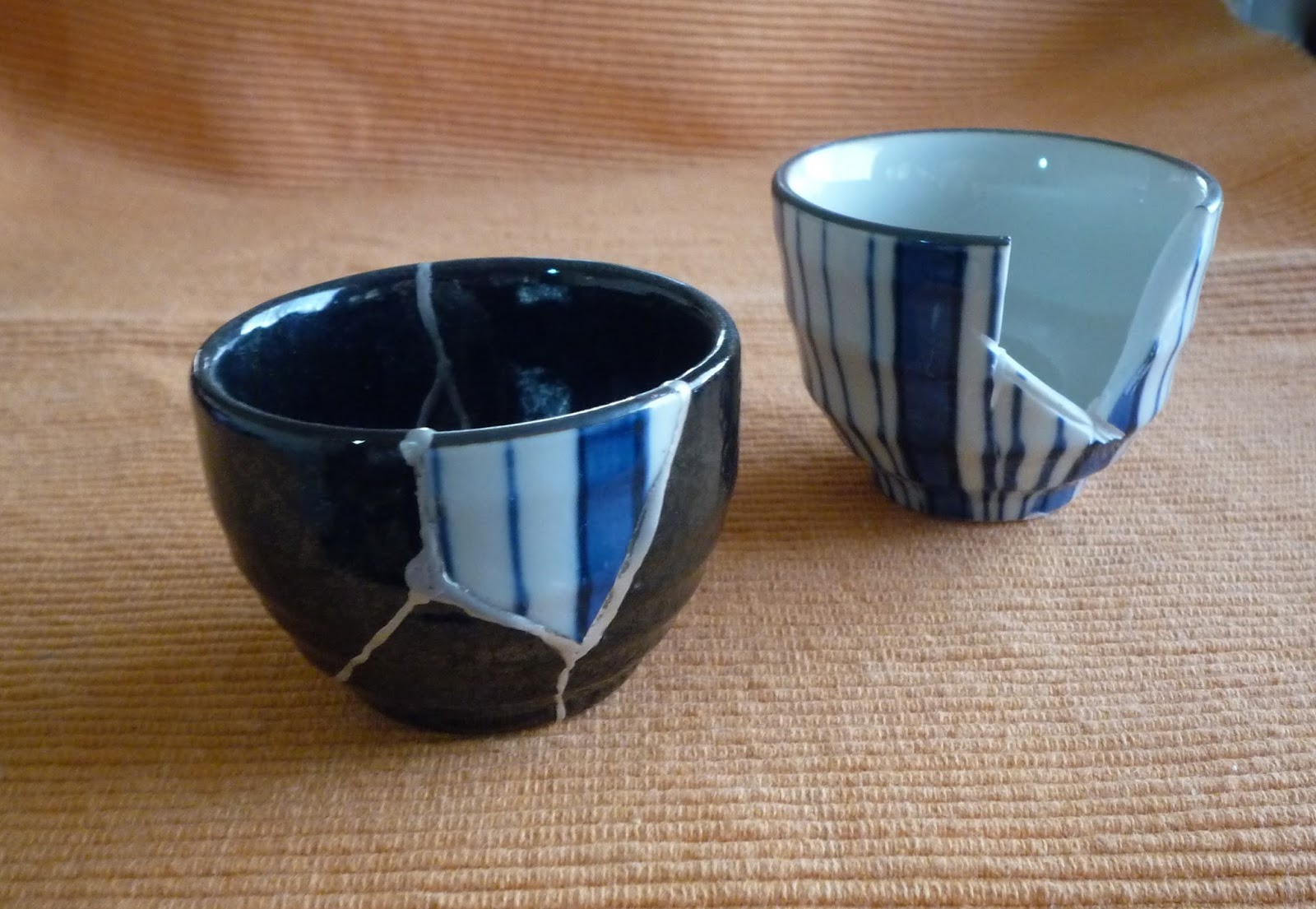
 I had prepared these sake-cups. 
Their size look almost similar, but in fact,their thickness and radius are a bit different.


First, I broke a cup and assembled it together again with lacquer leaving one piece aside.

Then, I cut out a piece from the other cup and put it into the assembled one.


This technique needs a skill to put together a piece which is not really 
the same shape with the lack, 
and also needs a sense of beauty to decide from which ceramics to take the piece to fill the lack.


2016-01-07

beginning of kintsugi


Recently I practiced repairing a tea cup with small clamps or  'kasugai'. 
This technique has developed in China.


The picture below is a famous celadon bowl from Nansong dynasty China.
It is in the National Museum in Tokyo.

The original holder of the bowl is the Muromachi Government's shogun Ashikaga Yoshimasa
 (足利義政: 1436-1490). At that time such  Chinese ceramics were of particular value in Japan.
As the bowl had got a crack, Yoshimasa sent a messenger with the bowl to China to seek a similar one.

But in Ming dynasty China there was no similar bowl, the cracked bowl was repaired with kasugai and sent back to Yoshimasa. 

However, Yoshimasa didn't like the way of repairing at all. It is said that it is when the kintsugi has begun to develop in Japan to repair broken ceramics more beautifully. 


2015-12-04

repairing with maki-e

Last month in the workshop I practiced repairing way using maki-e (蒔絵:lacquer painting ).
First I broke a small plate, then put it together again.

Normally I would finish it by drawing lacquer lines and spray gold powder on them. But this time I repaired it with maki-e.

Watching the joint lines for a while, I thought of painting a stick bug, though generally plants are painted such as bamboo or vines.
Maki-e nicely conseals the joint lines as if there were no seam !


2015-10-22

kintsugi of glass

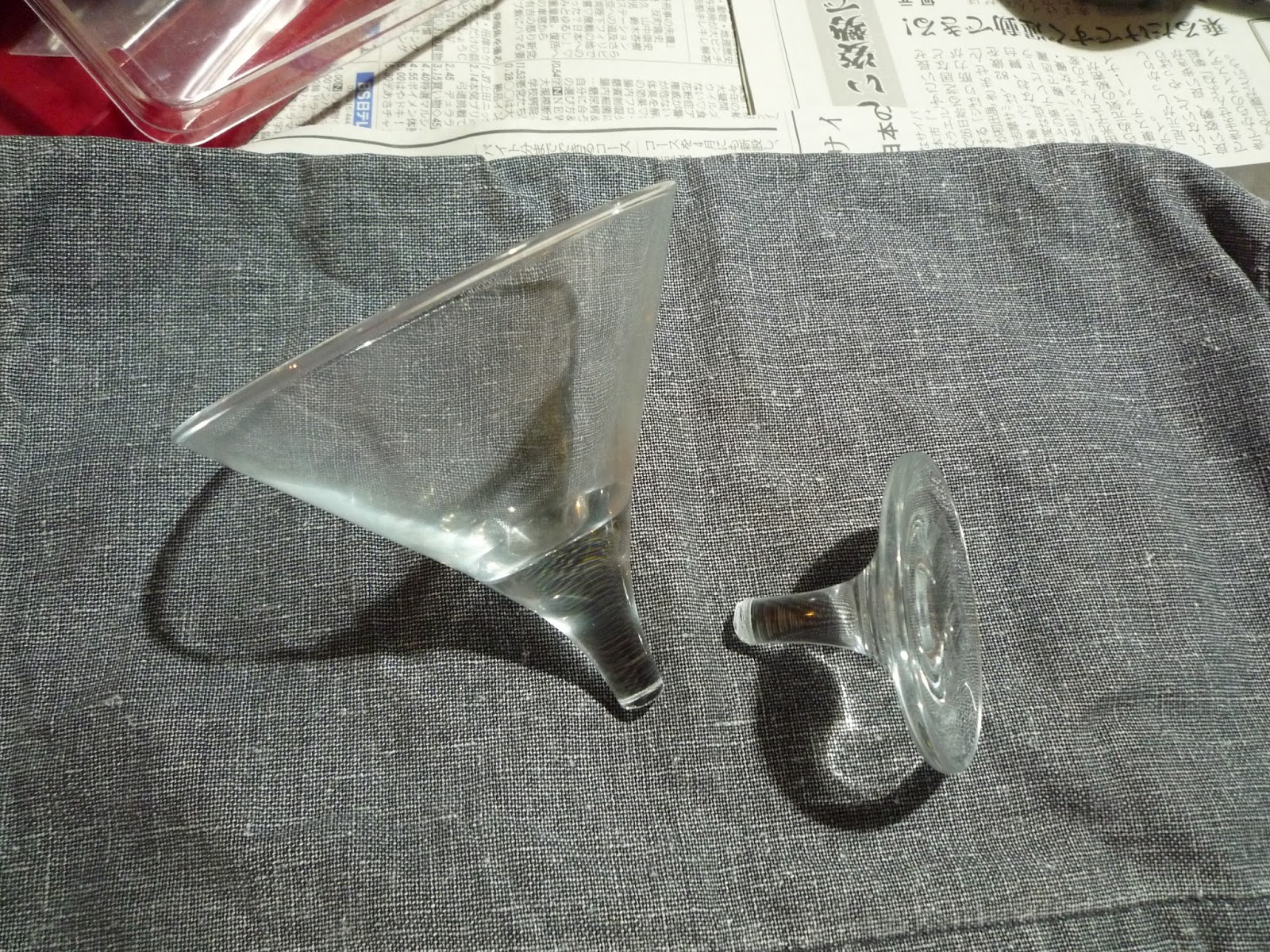
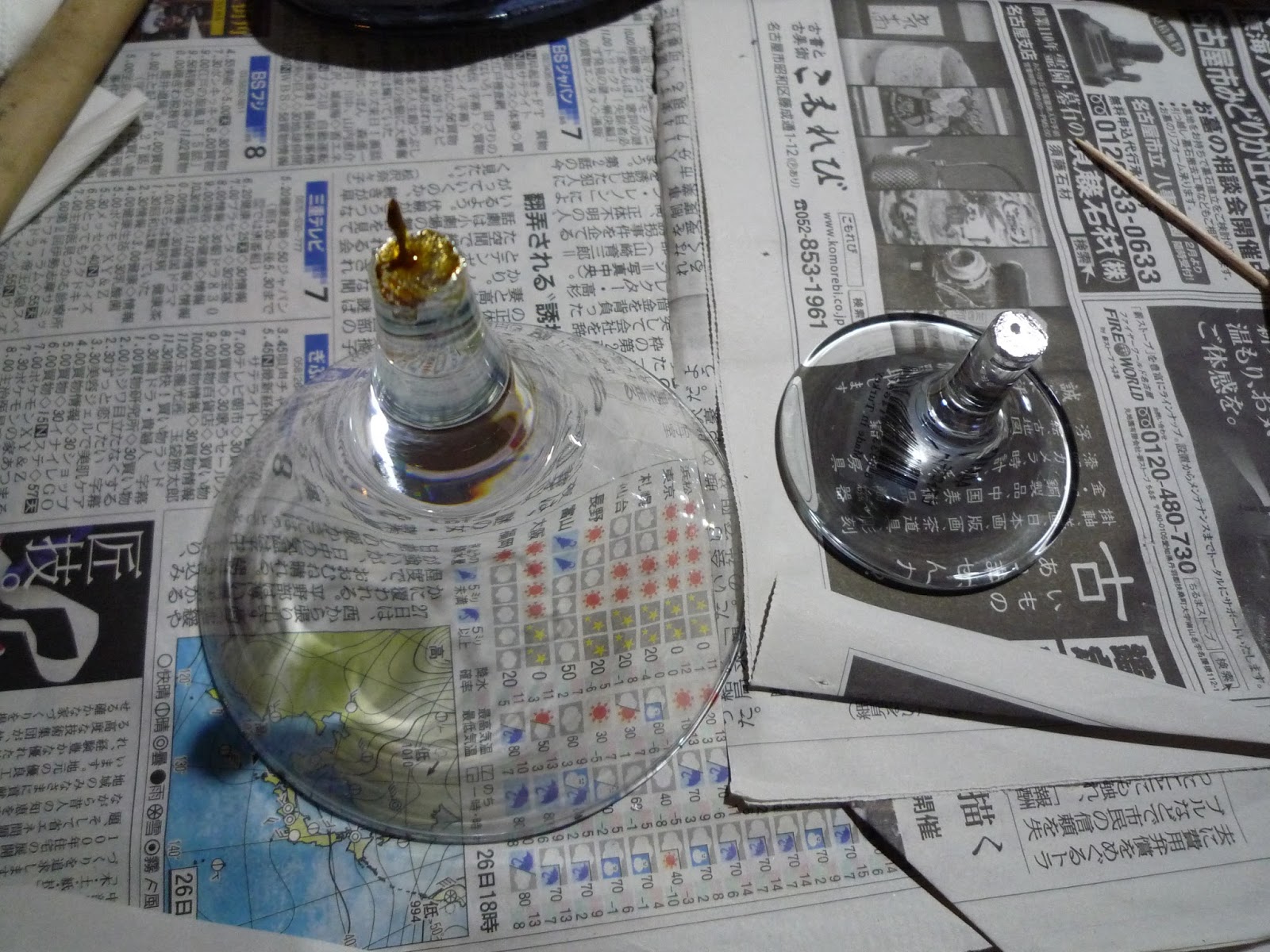
I fixed two broken glasses as exercise at the workshop . 
 I used chemical glue as well for the taller glass.